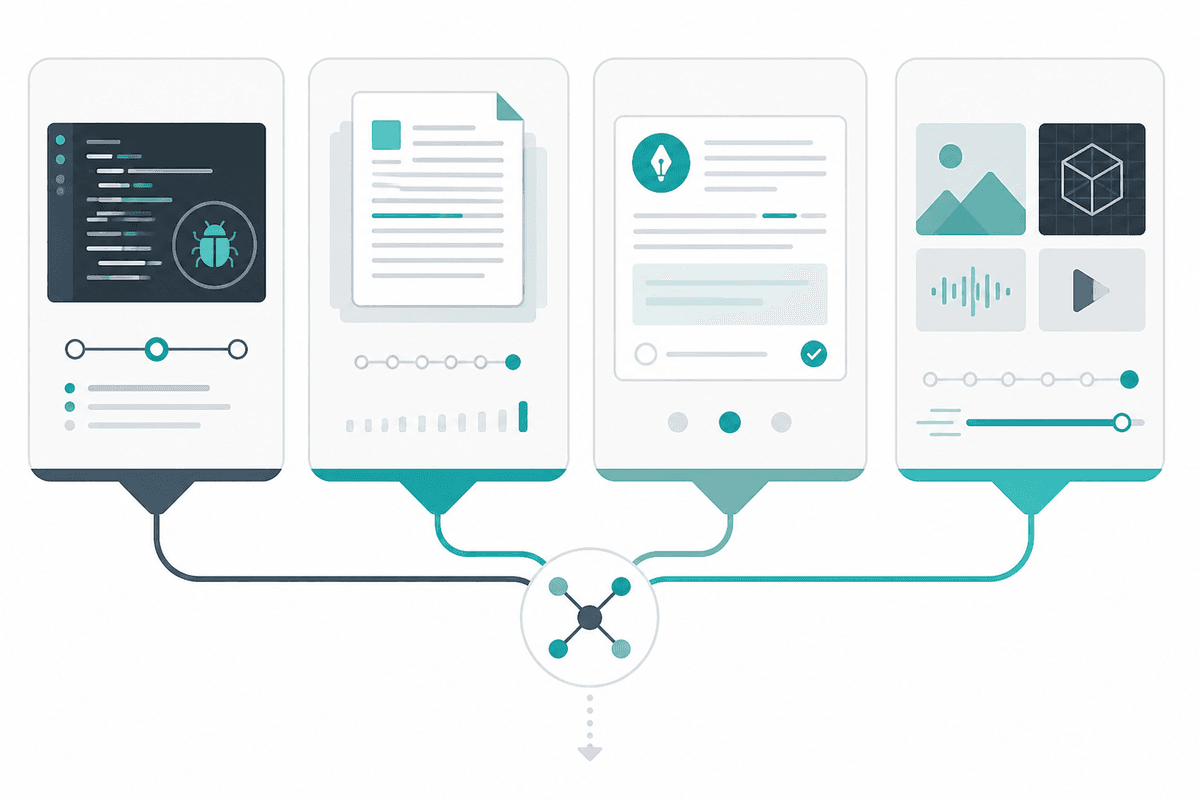

Grok 4.5: reproduce bugs, review small fixes, and break down tasks
Use Grok for reproducible debugging and task planning. Supply evidence, review suggested changes, run tests, and compare current model entries without fixed rankings.

Use this guide to prepare a Grok 4.5 task and inspect the result. The product entry provides current entry details. Check the selected name, mode, required inputs, and cost before a trial.
Prepare the input and acceptance criteria
Specify the question, audience, facts to preserve, and output shape. Verify image, file, web-tool, and context support in the selected mode; a family name alone does not establish those features. Supply material needed for this turn rather than assuming full history is retained.
Three steps for a controlled trial
- Fix one deliverable and a checklist before submission.
- Use a matching mode and record the actual input and settings.
- Inspect the result against the checklist, then revise one factor at a time. Record failures and actual cost too.
Original prompt examples to adapt
These examples express task intent, not guaranteed features or outcomes. Image-based examples require supported image input; requested word counts, facts, and code results still need checking.
Explain the root cause of this error, propose a minimal patch, and list 3 regression checks. Code/logs: …
Break “launch a campaign landing page this week” into a 7-day checklist table: task, dependency, owner field, acceptance criteria, risk.
Rewrite the text into three columns: Decisions / Todos (owner+due) / Risks. No fluff. Source: …
Write a PRD outline for an indie developer tools site: problem, users, core flow, MVP scope, non-goals. Keep under 600 words.
Explain “what is an agent” for beginners with 2 everyday analogies, then give 1 hands-on mini exercise.
Three practical workflows
Recipe A: reproduce and fix a bug
Supply expected behavior, reproduction steps, and a focused code or log excerpt. Ask for a cause and a minimal patch, inspect the diff, and run relevant tests in your own project. A model reporting success does not prove execution.
Recipe B: turn a vague request into a checklist
List deliverables, dependencies, acceptance criteria, and open questions. Have a person confirm assumptions before treating the list as a plan. Task breakdown does not imply an autonomous agent has performed the work.
Recipe C: prepare a technical explanation
Build the explanation from checked sources and examples. Review terminology and steps before making voice-over copy or visuals.
Compare other entries with the same criteria
Use matching material and criteria when comparing Gemini, Grok, GPT, DeepSeek, or Claude. The fixed legacy Claude entry currently maps to Claude Sonnet 5; a separate Opus 4.8 catalog entry is a different selection. Long-context scope, supported tools, and cost follow each current mode.
| Check | What to record |
|---|---|
| Evidence | Agreement with supplied sources and visible details |
| Structure | Required sections, length, and omissions |
| Coding or plans | Reproduction, minimal changes, executed tests, or acceptance criteria |
| Uncertainty | Unsupported statements and unresolved questions |
| Effort | Waiting time, actual cost, retries, and human revision |
Common issues and next steps
If the response fails, clarify the input and acceptance criteria before changing models. Do not equate rapid output with correctness, a long answer with reasoning quality, or a task list with completed execution.
Image and music entries linked below support separate production stages. Midjourney currently displays Midjourney Image; inspect generated visuals and Suno audio independently of the text plan.